

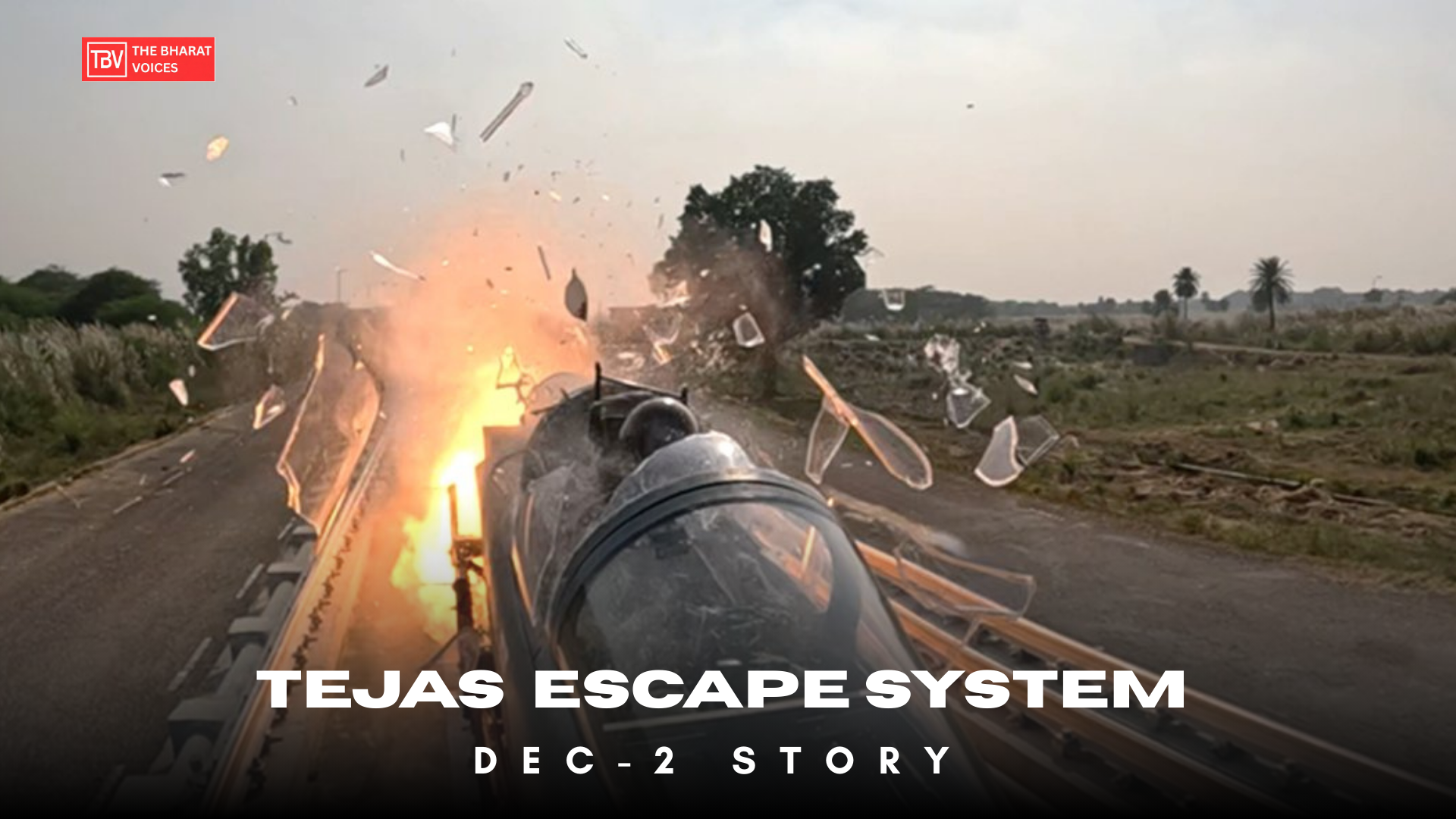
The test was conducted at the Rail Track Rocket Sled (RTRS) facility of the Terminal Ballistics Research Laboratory (TBRL) in Chandigarh.
A “dual‑sled” setup was used: the fore‑body section of the Tejas aircraft was mounted on a rocket sled system. Then, using multiple solid‑propellant rocket motors, the sled was accelerated down the track.
The sled reached a precisely controlled speed of 800 km/h.
On reaching that speed, the test triggered the aircraft’s escape (ejection) system — including canopy severance (i.e. blowing off the cockpit canopy), ejection sequencing, and full air‑crew recovery — with an instrumented “anthropomorphic test dummy” simulating a real pilot.
Both onboard and ground‑based imaging systems recorded the entire ejection and recovery sequence; the dummy’s forces, acceleration, moments etc. were all measured to assess stresses a real pilot would face.
Why this is important — what it proves?
The test validated three key safety‑system elements under high‑speed conditions: canopy severance, ejection sequencing, and air‑crew recovery.
Because the simulation used a realistic aircraft fore‑body, rather than just a dummy seat or static test‑rig, the demonstration is more meaningful — closer to “real world” than a static or zero‑zero ejection test.
Thanks to this test, India is now among a small group of nations that have the in‑house capability to test and validate high‑speed ejection/escape systems for fighters.
This reduces dependency on foreign suppliers for ejection‑seat / escape‑system hardware and testing. For jets like Tejas (and future Indian‑designed fighters), escape systems can now be developed, tested, and certified domestically.
What this does — and what remains
✅ Achieved / Strengthened
A working, high‑speed validated escape system — tested under realistic conditions.
Data on loads, stresses, sequence timings, ejection dynamics — crucial for certifying safety for pilots.
Confidence that escape seats / systems can be developed indigenously, for current and future fighters.
What’s not yet final or fully known?
This was a ground‑based test (rocket‑sled), not an in‑air ejection under real flight conditions (altitude, manoeuvres, G‑forces, etc.). So while promising, real-world certification may require flight‑tests or further simulations. Several media reports mention that further testing — maybe under varying conditions — would be needed before full deployment.
We don’t yet know publicly whether this system is cleared for all configurations of Tejas (or other jets), or for which variants this escape system will be certified first.
Who was involved / Reaction?
Agencies / organisations: DRDO worked in collaboration with Aeronautical Development Agency (ADA) and Hindustan Aeronautics Limited (HAL) for this test.
Oversight / monitoring: The test was witnessed by officials from Indian Air Force (IAF) and also by experts from the Institute of Aerospace Medicine (for aeromedical evaluation / certification).
Government reaction: The country's Defence Minister (named in sources) congratulated DRDO, ADA, HAL and all involved, calling this test a “significant milestone” for indigenous defence capability and pilot safety.
